
 1-888-828-7868

Utensils for Arthritic Hands: How to Choose Adaptive Cutlery
Utensils for arthritic hands are chosen by the obstacle they solve, because gripping standard cutlery becomes painful or unstable with arthritis. This plain guide compares weighted, lightweight, bendable and built-up options, and shows you where assistive eating devices fit in.
See a stabilizing utensil.png)
Why Standard Cutlery Becomes Difficult With Arthritis
Arthritis reduces grip strength and makes a pinch grip painful, so thin, smooth, lightweight handles are hard to hold. Small, slippery handles increase hand fatigue and spills at mealtimes. Purpose-built arthritis utensils, including kitchen utensils for arthritic hands, widen, weight or reshape the handle to ask less of painful joints and give a steadier hold with less effort. Noticing which part of the grip is hardest, whether holding, pinching or lifting, makes it easier to choose a better handle shape.
Built-Up Handle Utensils and Foam Tubing Grips
Built-up handle utensils have thicker, cushioned handles that need less finger closure to hold. Foam tubing for utensils is a low-cost add-on that slides over existing forks and spoons, enlarging the grip surface. Foam pipe insulation or self-adhering wrap can also be cut for a customized fit. Ready-made built-up cutlery suits long-term use, while tubing lets you adapt what you already own. Check that any wrap stays secure during use and can be washed or replaced when it becomes worn.
Weighted vs Lightweight Adaptive Utensils for Arthritis
Adaptive utensils for arthritis fall into two weight groups, so match the weight to your main difficulty. Lightweight utensils suit hand fatigue and a weak grip, though they may offer less steadiness. Weighted utensils suit mild shaking and add steadiness, but they can tire a weak or painful hand.
If you are unsure which applies, we can talk it through. Trying one of each type is the simplest way to compare comfort and steadiness at mealtimes, and an occupational therapist can help interpret what you notice.
Bendable and Angled Utensils for Limited Wrist Movement
Bendable heads can be angled toward the mouth without rotating a stiff wrist, which helps when range of motion is limited, including reduced forearm rotation. Angled cutlery works the same way with a fixed bend. Some sets offer separate left-hand and right-hand shaping, so check which hand will use the utensil before choosing. A bendable head can be adjusted as stiffness changes, while a fixed bend gives a consistent angle for those who prefer it. Ask a therapist if unsure.
How to Choose the Right Adaptive Utensils for Arthritis
Match the feature to the difficulty when choosing adaptive utensils for arthritis. For weak grip, try built-up handles, and for fatigue, lightweight cutlery. Where shaking is the problem, consider weighted or stabilizing utensils, and for a stiff wrist, bendable or angled heads. Also consider dishwasher-safe materials and handle diameter when choosing silverware for arthritic hands. Try several options where possible, because comfort differs from person to person. You can view the stabilizing spoon to compare.
When Adaptive Utensils Aren't Enough: Stabilizing and Powered Options
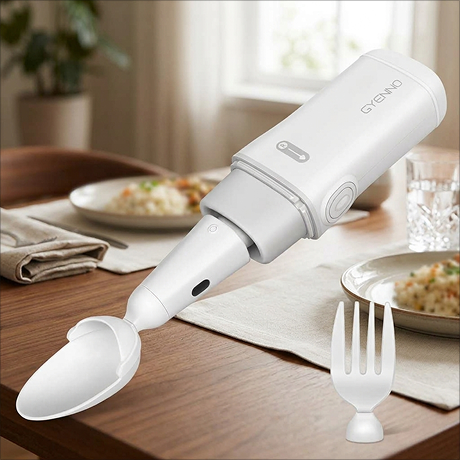
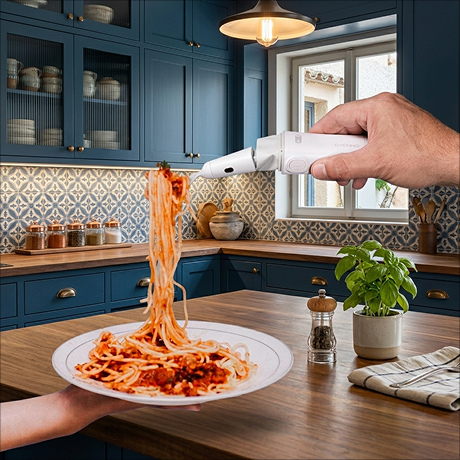
When arthritis comes with shaking that simple cutlery cannot manage, an electronic option may help. The Gyenno Bravo Twist tremor-stabilizing spoon, offered by Pisces Innovation, has a motorized handle that detects and counteracts shaking in real time, with magnetically attached spoon and fork heads. For severe loss of self-feeding ability, a manual assistive eating device such as the Neater Eater can help bring food to the mouth. Our team can explain each option clearly.
The Occupational Therapist's Role in Choosing Utensils
An occupational therapist can assess grip, range of motion and tremor, then recommend adaptive equipment and joint-protection habits that suit your meals. That assessment can also help with documentation needs. Our article on occupational therapy tremor guidance outlines the therapist's part in choosing equipment that supports independent mealtimes. Bring the utensils you currently use to the appointment, so the therapist can see where the difficulty starts and suggest practical changes. Follow-up reviews help adjust equipment as stiffness and strength change.
Frequently Asked Questions
There is no single best utensil; the right choice matches your main difficulty, whether grip, fatigue, shaking or wrist stiffness. Built-up or bendable handles help many arthritic hands, while weighted or stabilizing options add steadiness where shaking is the problem. Starting with the task that is hardest at mealtimes keeps the choice practical. A trial of two or three styles usually shows quickly which handle shape feels most comfortable and secure.
Weighted cutlery can improve steadiness for mild shaking, but it may fatigue a weak or painful hand, so it is not ideal for everyone. Match the weight to your main symptom: choose lighter options when pain or weakness dominates, and consider weighted ones when shaking is the bigger issue. If you are unsure which applies, an occupational therapist can assess grip, pain and tremor together. Many people start with the lighter option and adjust.
Weight can dampen mild tremor but does not remove it. For more pronounced tremor, an electronic stabilizing utensil that actively counteracts shaking may help more, though results vary by person. Weighted cutlery remains a simple, low-effort starting point for many people. If shaking continues to interfere with meals, ask a clinician about stabilizing options, and review your choice after a few weeks of regular use, noting any change in spills or fatigue.
Often, yes. Lightweight adaptive cutlery reduces lifting effort and hand fatigue, which suits people whose main issue is grip weakness rather than shaking. It is often paired with a built-up handle, so the lighter utensil is also easier to hold. If shaking is the main problem, a different type may suit better. Check the handle diameter as well as the weight, because a thin handle can still strain painful joints even when the utensil itself is light.
Bendable and angled utensils let the head reach the mouth without rotating a stiff wrist, which makes them a practical choice for limited wrist movement. Look for sets shaped for the left or right hand, whichever will use them, and check that the handle is easy to grip as well. Try the angle with your usual plate and bowl, since the right bend depends on how you sit and where the food is placed.